


Molecular Biology and Genetics of Rhizobia-Legume Interactions
Pablo del CerroOur research line investigates the molecular and genetic basis of the symbiotic relationship between nitrogen-fixing bacteria (rhizobia) and legume plants, with a particular focus on soybean (Glycine max), the world’s most economically important legume crop. We bridge fundamental molecular biology with applied agricultural research to address one of the most pressing challenges of our time: making agriculture more sustainable by reducing its dependence on chemical nitrogen fertilizers. Nitrogen is essential for plant growth, development, and seed production, yet it is poorly available in soils, leading to the extensive and costly use of chemical fertilizers worldwide. Legumes offer a natural solution: they have evolved the ability to establish symbiosis with rhizobia, which convert atmospheric nitrogen into plant-usable forms within specialized root organs called nodules. Understanding and optimizing this partnership to replace chemical fertilizers is the core aim of our work.
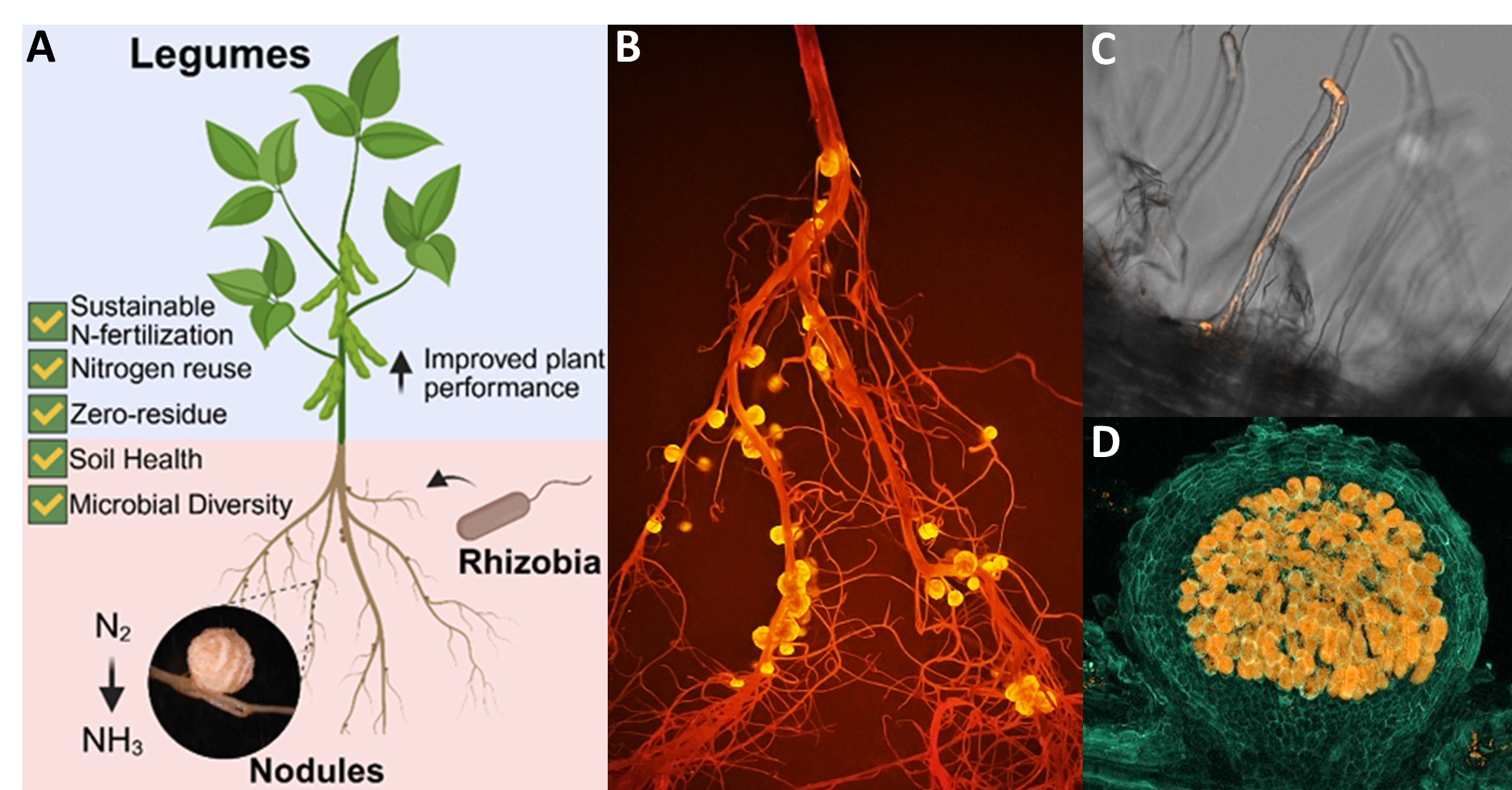
(A) Rhizobia-legume symbiosis and its environmental benefits.
(B) Root nodules colonized by rhizobia expressing a fluorescent marker (GFP).
(C–D) Infection threads (top panel), a structure that facilitates the controlled entry of rhizobia into the root and fully-colonized nodules (lower panel) of legume plants inoculated with Rhizobia expressing fluorescent marker (DsRed).
Symbiotic compatibility and signal recognition. A central question driving our research is what determines compatibility between a given rhizobial strain and a legume cultivar. The use of rhizobia as bioinoculants in agriculture is limited by host specificity: not every strain can form an effective symbiosis with every legume. We study the molecular dialogue behind this compatibility from both sides. On the bacterial side, we focus on the molecules the plant recognizes: surface polysaccharides, Nod Factors, and effector proteins delivered into the plant through the Type III Secretion System. On the plant side, we study the traits that switch on the symbiotic program in response to these bacterial molecules, as well as the immune responses that can block symbiosis.
AI-guided protein design to engineer symbiosis. We aim to improve rhizobia-legume compatibility using AI protein design. With a pipeline that combines RFdiffusion, ProteinMPNN, and AlphaFold, we are generating proteins that could broaden symbiosis to otherwise incompatible pairs, opening a route to a new generation of broadly compatible rhizobial inoculants.
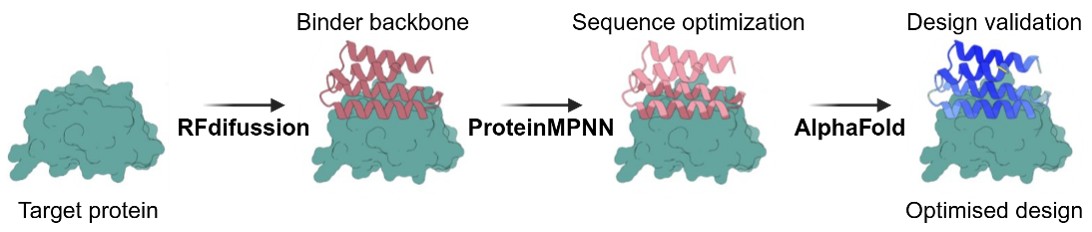
Schematic representation of the design pipeline followed during our binder-design campaign. Figure adapted from Pacesa et al. 2025.
Plant and microbe omics for N-fixation improvement. While our molecular work dissects the individual components of symbiotic compatibility, nitrogen fixation in agricultural settings is shaped by the interaction of many more variables: plant genotype, rhizobial strain, the wider soil microbiome, and environment. Our research aims to understand and exploit this complexity through an integrated omics framework.
On the plant side, we sequence and phenotype large soybean diversity panels (including over 600 genotypes spanning elite grain and edamame varieties, landraces, and wild soybean), measuring nitrogen fixation traits and using genome-wide association studies (GWAS) to identify haplotypes underlying improved N-fixing symbiosis. On the rhizobial side, we have generated high-quality genome sequences for a collection of over 200 competitive rhizobial strains, and are using comparative genomics to characterise their diversity and identify the most promising candidates for compatibility testing across contrasting plant haplotypes. We are now extending this to the wider root microbiome, using metagenomic sequencing and bioinformatics to link soil microbial community composition to plant-rhizobia symbiotic performance. The goal is genomics-informed matchmaking: identifying the legume genotype, rhizobial strain, and microbial community combinations that together maximise symbiotic nitrogen fixation.
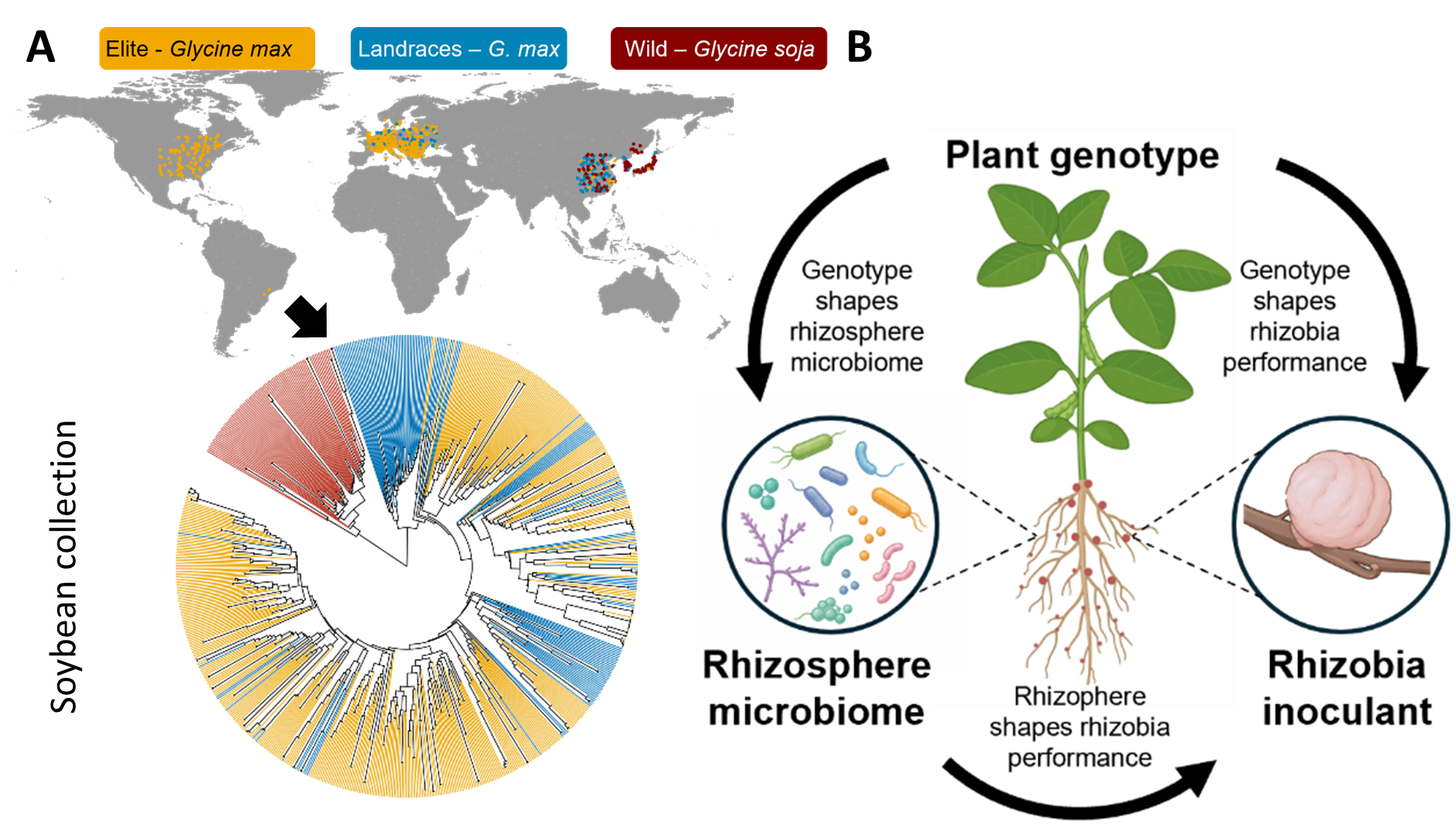
(A) A soybean germplasm collection of over 600 genotypes of worldwide origin, including commercial varieties, landraces, and wild accessions, is present in our laboratory.
(B) Symbiotic nitrogen fixation depends on the complex interaction between plant genotype, rhizobia strain and root microbiome.
Applied research: sustainable soybean production. We translate this knowledge into practical solutions for sustainable agriculture. The EU and Spain have increased soybean production in recent years, yet most domestic demand is still met through imports. Our applied work aims to increase local, sustainable soybean production while reducing the environmental footprint of nitrogen fertilizers. To this end, we run field trials with our rhizobia and soybean panels to identify cultivar-strain combinations that perform best under local climate and soil conditions, evaluating both symbiotic efficiency and plant growth.
- Nicola Cook, Giulia Gobbato, Catherine Jacott, Clemence Marchal, Chen Yun Hsieh, Anson Ho Ching Lam, James Simmonds, Pablo del Cerro … Myriam Charpentier. (2025). Autoactive CNGC15 enhances root endosymbiosis in legume and wheat. Nature. DOI: https://doi.org/10.1038/s41586-024-08424-7.
- Alison Tidy, Laura Siles, Catherine Jacott, Rachel Wells, Smita Kurup, Zoe A Wilson (2025). Large scale phenotyping on the effect of heat and cold stress on Brassica napus during floral development. Plant Stress 17(100957) DOI: doi.org/10.1016/j.stress.2025.100957
- Catherine Jacott, Pablo del Cerro. (2024). CNGC15-DMI1 Gating in Nuclear Calcium Signaling: Opening New Questions and Closing Controversies. Journal of Experimental Botany. DOI: 10.1093/jxb/erae352.
- Catherine Jacott, Henk-jan Schoonbeek, Gurpinder Singh Sidhu … Rachel Wells. (2024). Pathogen lifestyle determines host genetic signature of quantitative disease resistance loci in oilseed rape (Brassica napus). Theoretical and Applied Genetics 137(3):1-9. DOI: doi.org/10.1007/s00122-024-04569-1
- Hicret Asli Yalcin, Catherine Jacott, Ricardo Ramirez-Gonzalez … Rachel Wells (2024). A complex receptor locus confers responsiveness to necrosis and ethylene‐inducing like peptides in Brassica napus. The Plant Journal. 119(1) 266-282. DOI: doi.org/10.1111/tpj.16760
- Pablo del Cerro, Nicola Cook, Rik Huisman, Pierre Dangeville, Lauren Grubb, Clemence Marchal, Anson Ho-Ching-Lam, Myriam Charpentier. (2022). Engineered CaM2 modulates nuclear calcium oscillation and enhances legume root nodule symbiosis. PNAS. 119 (13) e2200099119. DOI: doi.org/10.1073/pnas.2200099119.
- Paula Ayala-García, Irene Jiménez-Guerrero, Catherine Jacott, Francisco Javier López-Baena, Francisco Javier Ollero, Pablo del Cerro, Francisco Pérez-Montaño. (2022). The Rhizobium tropici CIAT 899 NodD2 protein promotes symbiosis and extends rhizobial nodulation range by constitutive nodulation factor synthesis. Journal of Experimental Botany. 73(19). DOI: doi.org/10.1093/jxb/erac325
- Catherine Jacott, Christopher Ridout, Jeremy Murray. (2021). Unmasking Mildew Resistance Locus O, Trends in Plant Science, 26(10): 1006-1013. DOI: doi.org/10.1016/j.tplants.2021.05.009.
- Catherine Jacott, Myriam Charpentier, Jeremy Murray, Christopher Ridout (2020). Mildew Locus O facilitates colonization by arbuscular mycorrhizal fungi in angiosperms, New Phytologist, 227: 343-351. DOI: doi.org/10.1111/nph.16465.
- Anna Newman-Griffis, Pablo del Cerro, Myriam Charpentier, Iris Meier. (2019). Medicago LINC complexes function in nuclear morphology, nuclear movement, and root nodule symbiosis. Plant Physiology, 179(2): 491-506. (Article). DOI: doi.org/10.1104/pp.18.01111.